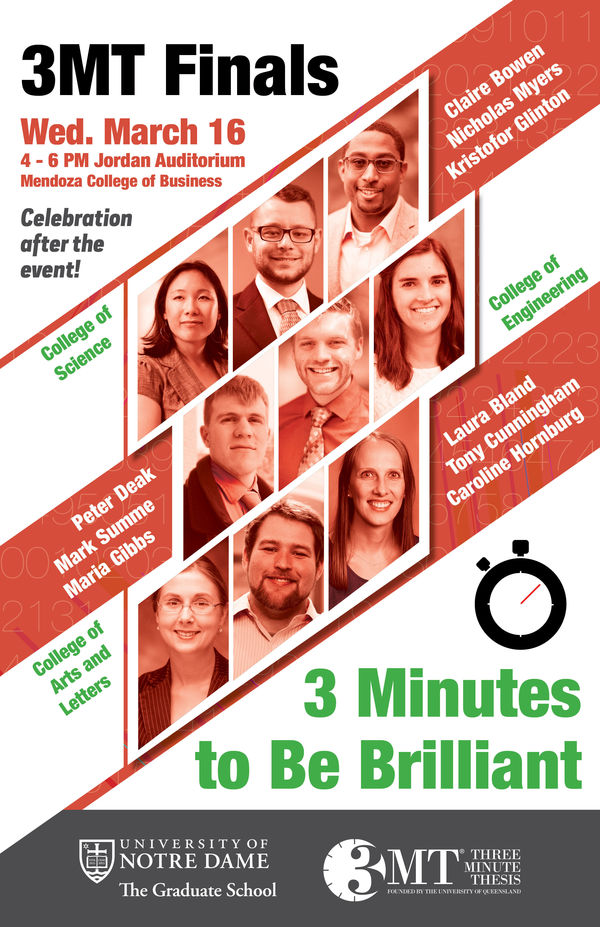
Nick, you were brilliant! $1500 prize in 3MT
Nicholas Myers came in 2nd place in the 3MT Thesis Summary event this evening, winning an enormous sum (photo coming tomorrow).
Nicholas Myers came in 2nd place in the 3MT Thesis Summary event this evening, winning an enormous sum (photo coming tomorrow).
Finals for the 3MT are Wednesday March 14, 4-6 pm, in the Jordan Auditorium. Come cheer for the presenters!
July 4-9, 2016. London School of Hygiene and Tropical Medicine
The short course is aimed at personnel who are involved and/or interested in medical product quality (medicines, diagnostics, vaccines). The course will be aimed at global public health issues, and those found in low-, middle-…
Thursday, Feb. 11, 2016: The Nation (one of the main Kenyan newspapers) published an article about our effort to detect low quality drugs in Eldoret, Kenya.
…
Notre Dame juniors Tabitha Healy and Paulina Eberts are assisting with the repair of four HPLC systems that will be donated to labs in Africa. They accompanied Prof. Lieberman to Eldoret over the winter break.
Tabitha and Paulina working with one of the Waters HPLC instruments in the drug analysis…
3645 poster abstracts were submitted for Pacifichem 2015, 350 were nominated for the poster competition, and 54 of those won. Congratulations to Nick for his excellent work and ability to WOW the judges!
Nicholas Thurin, a senior at Penn High School, presented a poster on his air pollution test card at the Dec. 5, 2015 Purdue-Indiana-Notre Dame University inorganic chemistry conference. Nick generated the nitrogen oxides using Ira Remsen's method*, diluted the gases to part-per-million levels, then designed…
Emily Mediate worked on the PAD project in 2012, organizing and testing some of the Kenyan antibiotic samples and helping Nick get the saltPAD off the ground. She later did research in Uganda focusing on the effectiveness of AIDs interventions.
The Rhodes Scholarship supports students in…
A hundred policy makers, regulatory officials, and health care providers from Central and South America experiment with a new technology for detecting falsified medications. Paper analytical devices (PADs) are employed to determine which sample of a tuberculosis medication has been adulterated with…
AMPATH received support for a program to provide incentives for Kenyan patients to enroll for health insurance; the PAD project will be supported to implement a field screening program working with the pharmacovigilence team at Moi Hospital. Congratulations to all!
The US Agency for international…
Last Thursday May 21, I had the opportunity to visit the Center for Pharmaceutical Advancement and Training in Accra, Ghana. This lab facility was established by USP in May of 2013, so it's just two years old. The director is…
The short segment aired Saturday May 23 on BBC International's HealthCheck program as part of a larger theme of finding and fighting poor quality medications; I'll post a link as soon as I get it from the producers.
Here Zoe Flood is shooting video of some of the pharmacy students using…
The 2012 Point of Care Diagnostics meeting in Nairobi, Kenya brought together academic researchers and public health, policy, and medical caregivers in developing countries. A common theme was the difficulty of the path from research ideas in university laboratories to effective diagnostic tools…
Our recent publication in the American Journal of Tropical Medicine and Hygiene was picked up in an article on SciDevNet.
The $1,000 award will be conferred on May 29, 2015 at the Joint Great Lakes and Central Regional Meeting of the American Chemical Society. …
Access to high-quality medicine is a basic human right, but more than four billion people live in countries where many medications are substandard or fake. Marya Lieberman of the Department of Chemistry and Biochemistry at the University of Notre Dame and Abigail Weaver, a postdoctoral associate in the University’s Department of Civil Engineering and Environmental and Earth Sciences, took up the challenge of how people in developing countries could detect low-quality antimalarial drugs without expensive equipment and without handling dangerous chemicals.